Why Do Couples Keep Having the Same Arguments?

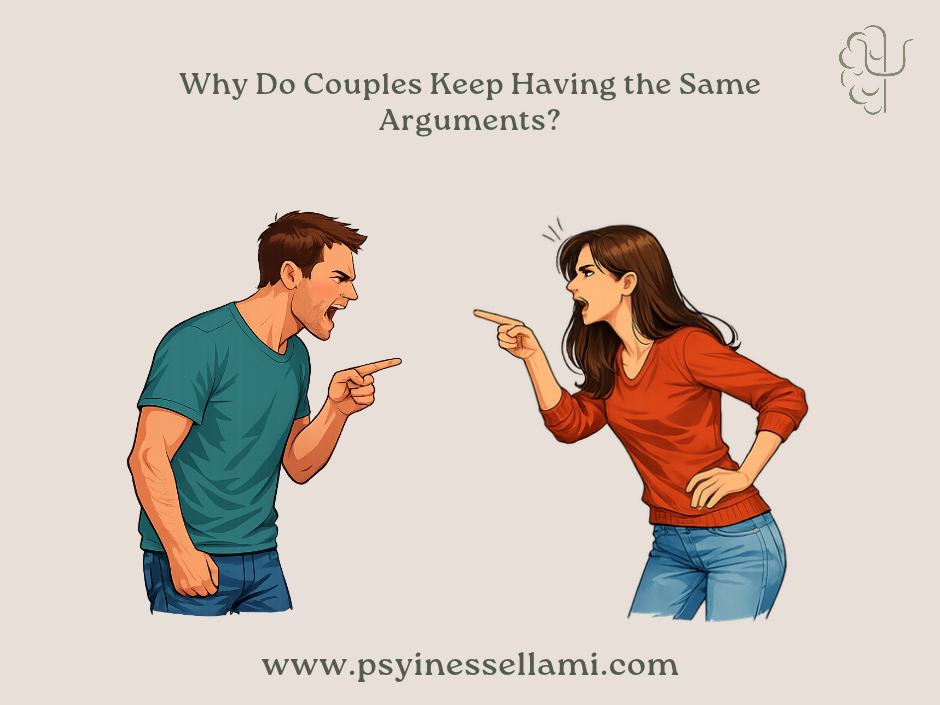
You may sometimes feel like you and your partner keep having the same argument over and over again.
Household responsibilities. Money. Children. Time spent together. Family. Phone use. Jealousy. Communication.
The conversation starts, criticism appears, each person tries to make their point understood, and eventually the discussion ends in anger, silence or frustration.
A few days or weeks later, the same situation happens again.
Why do some couples keep having the same arguments, even when both partners genuinely want things to change?
Because, in many cases, the problem is not only the topic of the argument. It is also the way partners interact when a disagreement arises.
The Same Arguments in a Relationship: The Visible Issue Is Not Always the Real Problem
A couple may argue about household chores, while the disagreement is actually connected to something deeper.
For example:
“You never help around the house.”
may express feelings of being overwhelmed, unappreciated or treated unfairly.
Similarly:
“You're always on your phone.”
may be connected to a need for attention, closeness or recognition.
This does not mean that the practical issue is unimportant. Household responsibilities, family organization or the amount of time spent together can genuinely be sources of disagreement.
However, conflict can take on another dimension when a partner's behavior is interpreted as a message about the relationship:
“You don't do your share” can become:
“I can't rely on you.”
“You never want to talk” can become:
“What I feel doesn't matter to you.”
“You keep asking me the same questions” can become:
“You don't trust me.”
The conflict is then no longer only about what happened, but also about what each partner believes the situation means.
Trigger vs. Underlying Problem: Two Different Things
It can be helpful to distinguish between the trigger and the underlying problem.
The trigger is the event that starts the argument at a particular moment.
The underlying issue relates to what that situation represents for the partners.
For example, one partner comes home later than expected without letting the other know.
The immediate issue is concrete: they came home late.
But the emotional reaction may be connected to something else:
“I feel like I can't rely on you.”
The other partner may hear this reaction as an accusation:
“Whatever I do, you think I'm doing something wrong.”
They become defensive.
The first partner then feels even less understood and pushes the conversation further.
The second partner feels increasingly criticized and withdraws.
The argument may eventually move far away from the original issue.
This is often why couples feel that they are always arguing about the same thing, when they may actually be caught in a repetitive relationship pattern.
The Interactional Cycle: When Each Person Reacts to the Other's Reaction
In some couples, conflicts follow a relatively predictable pattern.
One partner expresses dissatisfaction.
The other feels criticized and becomes defensive.
That reaction is experienced as a lack of understanding.
The first partner insists even more strongly.
The other feels increasingly pressured and withdraws.
The withdrawal is interpreted as indifference.
The first partner insists again.
The cycle intensifies.
These dynamics can take different forms.
In some couples, one partner repeatedly seeks more discussion, reassurance or emotional connection, while the other tries to reduce tension by creating distance.
In others, both partners respond to criticism with criticism, until the conversation becomes an accumulation of complaints and counter-complaints.
The important point is that each partner's behavior influences the other's response.
It can therefore become difficult to determine who is “the problem.”
The couple may instead be caught in a cycle in which both partners unintentionally contribute to maintaining the difficulty.
Why Is It So Difficult to Break the Cycle?
Because each partner usually has a reason for reacting the way they do.
A person who keeps insisting may be looking for reassurance, understanding or emotional connection.
A person who withdraws may be trying to avoid escalation, regain a sense of calm or protect themselves from feeling criticized.
The difficulty is that the strategy used to meet one person's needs can sometimes have the opposite effect on the other partner.
For example, the more one person insists on getting an answer, the more the other may feel the need to step back.
But the more the other person withdraws, the more the first partner may feel the need to insist.
Each person is trying to solve the problem in their own way, while unintentionally reinforcing the other's reaction.
This is one reason why some recurring relationship conflicts can be particularly difficult to change.
Emotional Needs Sometimes Remain Unspoken
Repeated conflicts can also be maintained by needs that are difficult to express directly.
Anger may sometimes be accompanied by fear, sadness, disappointment or loneliness.
Defensiveness may sometimes hide feelings of helplessness, shame or the fear of never being good enough.
But these emotions are often hidden behind more visible behaviors such as criticism, silence, anger, justification or withdrawal.
A partner may say:
“You never pay attention to me.”
while the underlying need may be:
“I want to feel that I matter to you.”
The other partner may respond:
“You're always criticizing me.”
while their internal experience may be:
“I feel like nothing I do is ever good enough.”
When needs remain hidden behind criticism, each partner responds to the surface of the conflict without necessarily addressing what is happening underneath it.
Resentment Can Reinforce Recurring Relationship Conflicts
When disagreements remain unresolved, resentment can gradually build.
A current situation may then reactivate several past experiences.
An argument about household responsibilities may no longer be about what happened today.
It may bring back all the previous times when one partner felt that they were carrying too much of the responsibility alone.
Similarly, a request for reassurance may be influenced by previous experiences of disappointment or emotional unavailability.
The couple is no longer responding only to the present moment.
The history of the relationship becomes part of the current conflict.
This is one reason why an apparently small disagreement can sometimes trigger a disproportionately strong emotional reaction.
Communication Is Not Simply About Talking More
When couples experience difficulties, one of the most common pieces of advice is:
“You need to communicate better.”
But communicating more does not necessarily solve the problem.
A couple can talk for hours and still remain stuck in the same pattern.
The question is also how partners communicate when they disagree.
Do they both try to understand each other, or are they mainly trying to defend themselves?
Can emotions be expressed without immediately being dismissed?
Are requests expressed clearly?
Do partners talk about their own experience, or do they attribute intentions to each other?
Can they interrupt an escalating argument before it becomes too intense?
These factors can matter more than the amount of communication itself.
How Can Couples Break the Cycle of Repeated Arguments?
The first step is often to observe the cycle rather than immediately trying to determine who is right.
A few questions can help:
What usually triggers our arguments?
What happens immediately afterward?
How do I react when my partner does this?
How does my partner respond to my behavior?
What does each of us seem to be trying to obtain or avoid in these moments?
What need might be underneath my reaction?
This type of observation can sometimes reveal that the conflict follows a relatively predictable pattern.
It then becomes possible to work not only on the content of the argument, but also on the relationship pattern itself.
Small Changes Can Sometimes Shift the Cycle
There is no magic formula that can eliminate all conflict from a relationship. Disagreements are a normal part of being a couple.
The goal is instead to gradually change the way those disagreements are handled.
This may include:
describing your own feelings rather than attributing intentions to your partner;
making a specific request instead of making a general accusation;
identifying the need behind a criticism;
recognizing your own contribution to the cycle without taking responsibility for the entire problem;
temporarily pausing a discussion when emotions become too intense;
returning to the topic rather than leaving the conflict permanently unresolved;
trying to understand your partner's perspective before trying to prove that they are wrong.
These changes can take time, particularly when the pattern has existed for a long time.
When Can Couples Therapy Be Helpful?
Not every disagreement requires couples therapy.
Conflict is an inevitable part of relationships, and many disagreements can be addressed through communication and mutual adjustments.
However, couples therapy may be helpful when the same conflicts keep returning despite both partners' efforts, when communication has become consistently difficult, or when resentment and emotional distance are gradually developing.
Couples therapy can provide a structured space to observe the interactions between partners and better understand what keeps the conflict cycle going.
The goal is not to identify who is right or wrong.
Instead, the focus can be on understanding:
“What happens between us when we enter this cycle, and how can we respond differently?”
Therapeutic work can also help partners identify needs that are difficult to express, work on communication and develop more effective ways of managing disagreements.
You Don't Have to Wait Until Your Relationship Is in Crisis
Seeking professional support does not necessarily mean that a couple is on the verge of separation.
Some couples seek therapy when difficulties are beginning to develop, precisely because they want to prevent tensions from becoming more entrenched.
Others want to understand a pattern that has been repeating for years or rebuild a more satisfying way of communicating.
The goal of couples therapy is not to impose an ideal model of what a relationship should look like. Every couple has its own history, values, needs and circumstances.
The work is instead about helping partners better understand their relationship dynamics and develop ways of interacting that are more consistent with what they want for their relationship.
Conclusion
When couples keep having the same arguments, it can be tempting to believe that the problem lies simply in the topic of the disagreement or that one partner needs to change.
However, recurring conflicts are often connected to interactional cycles in which each person reacts to the other's behavior.
Understanding this cycle can shift the focus. Instead of asking only who is right or wrong, partners can begin to look at what happens between them when conflict arises.
Disagreements do not necessarily mean that a relationship is unhealthy or failing. What also matters is how partners learn to navigate those disagreements together.
When the same difficulties continue despite both partners' efforts, couples therapy can provide a space to understand these patterns and explore new ways of interacting.
If you would like professional support with difficulties in your relationship, I offer online couples therapy in a confidential and respectful setting.


Comments